IoT In Agriculture
Home > Application > IoT In Agriculture: Top 7 Use Cases to Know in 2024
Farming has always been a tough gig. If you bought a farm today, you’d be facing some serious challenges that farmers have been battling for centuries – poor soil fertility, water scarcity, crop disease, labor shortages…the list goes on. The traditional farming techniques that were once reliable don’t cut it anymore. With the world’s population booming, those old-school techniques are no match for meeting the rapidly rising demand for food. That’s where the IoT and smart agriculture come in to save the day. In this article, we will dive into the main applications of IoT in agriculture. So, let’s dive into it.
Smart agriculture or “smart farming” mainly refers to leveraging modern technology in agriculture. By deploying IoT sensors and devices to collect various data, farmers can make informed decisions to improve all aspects of their operations – livestock and crop farming alike.
Key principles of smart agriculture include:
– Monitoring and data-driven decision making
– Precise input management (water, fertilizer, pesticides, etc.)
– Automation and remote control of farming activities
– Integration of multiple emerging technologies (sensors, connectivity, AI, drones, etc.)
While not as popular as consumer IoT devices yet, the smart agriculture IoT market is very dynamic with steadily growing adoption. COVID-19 actually boosted this market’s growth, with supply chain issues and worker shortages driving the CAGR up to 9.9%. Recent reports peg the smart farming market at $12.5 billion in 2022, set to reach $71.753 billion by 2032. Since the market is still in its developmental phase, plenty of opportunity remains for businesses ready to get involved.
IoT architecture for smart agriculture is comprised of four integrated layers: perception, network, cloud, and application. These layers enable efficient data collection, secure transmission, reliable storage.
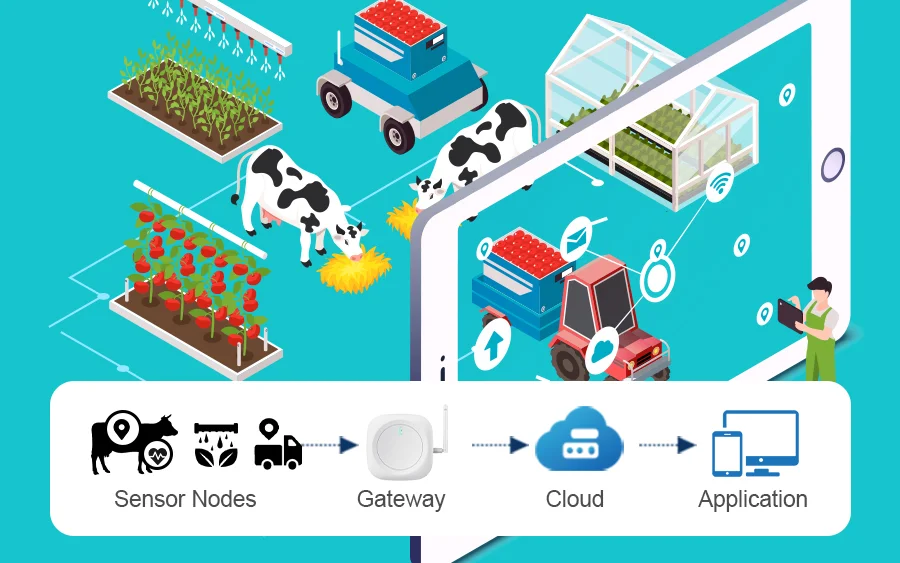
Smart farming has evolved far beyond just a concept. Across the world, IoT technologies have taken root in virtually every area of agriculture:
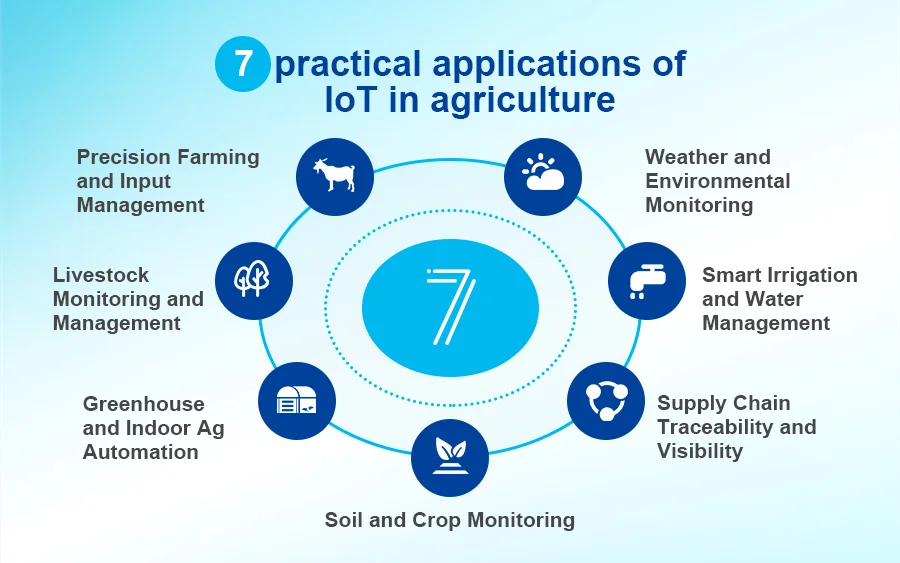
Through sensors monitoring soil moisture, nutrients, temperature and more, farmers gain deep visibility into soil and crop conditions. Beyond pinpointing issues faster, growers can use the data to forecast potential problems and apply preventative treatment.
Rather than applying uniform inputs (water, fertilizers, pesticides) across entire fields, precision farming and variable rate technology tailor inputs based on granular data and specific conditions on a plant, row or zone level. This radically reduces waste.
From cattle and dairy tracking to poultry monitoring, IoT technology optimizes and simplifies livestock management. Smart ear tags, biometric wearables, video cameras and environmental sensors give deep insights into animal well-being, nutrition and development.
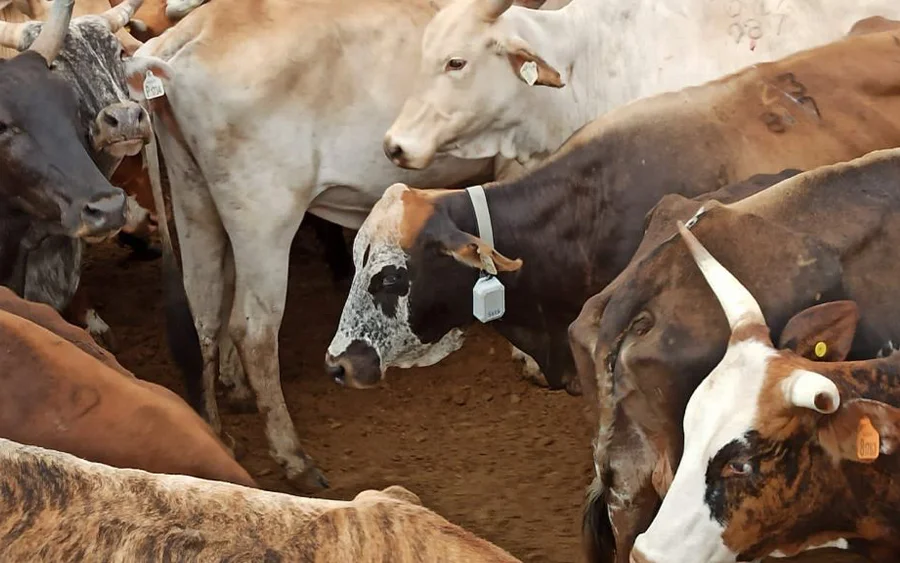
A Paraguay ranch deployed cattle trackers with motion sensors to monitor their free-range cattle’ locations and behaviors to detect abnormal issues like injury, falling, or theft.
Traditional greenhouses and emerging indoor vertical farms are becoming controlled environments automated by IoT. Every factor can be sensed and optimized – from climate control, supplemental lighting, hydroponic nutrients and beyond.
At a Dutch greenhouse facility, installing HVAC sensors and smart meter plugs trimmed energy costs by 50%.
Weather stations packed with smart sensors and connectivity enable up-to-the-minute micro-climate monitoring for crops. Data streams into platforms analyzing potential risks like frost, drought, rainfall and pest pressure to trigger real-time alerts for intervention.
With IoT water monitoring and smart irrigation systems, farmers can maintain ideal moisture levels while optimizing usage. Integrated weather data and soil sensors drive automated drip irrigation schedules customized by zone, crop and growth cycle.
Using the unique identities of connected IoT sensors and devices, agricultural companies can automatically log a digital trail tracking crops from the field to transportation, processing, distribution and retail. This boosts visibility and accountability across the supply chain.
While smart agriculture involves many emerging technologies, IoT serves as the core foundation, incorporating and interconnecting tools like:
Sensors and IoT Devices
A vast ecosystem of connected sensors deployed across fields measure and monitor key data points like moisture, temperature, rainfall, soil nutrients, leaf health, equipment operations and more. Advanced sensor types include:
Connectivity Technologies
Data captured by sensors needs reliable mechanisms to transmit to cloud platforms and software applications for analysis and action. Depending on connectivity needs, bandwidth and energy requirements, smart ag solutions integrate technologies like:
Cloud Computing and Data Analytics
With millions of datapoints streaming from IoT sensors across the farm, ultra-scalable cloud computing and big data analytics platforms are critical for smart agriculture. Cloud ecosystems like AWS IoT and Microsoft Azure IoT provide the infrastructure for ingesting, processing and visualizing sensor data at massive scale.
Drones and Aerial Imagery
Unmanned aerial vehicles (UAVs or drones) with high-res cameras provide an aerial view of entire crop fields. When images are combined with machine learning, aerial surveys can assess overall crop health, spot gaps in irrigation systems, identify pest/weed infestations, and more. Drones can also spray targeted treatments.
Robotics and Autonomous Vehicles
Smart machines like autonomous tractors and robot swarms can automate labor-intensive field tasks like planting, pruning, weeding and harvesting using a combination of GPS, computer vision, sensors and autonomous navigation.
IoT in agriculture, as in other sectors, provides numerous advantages.
While the benefits of IoT in agriculture are immense, developing and implementing smart farming solutions requires careful planning and consideration of key factors:
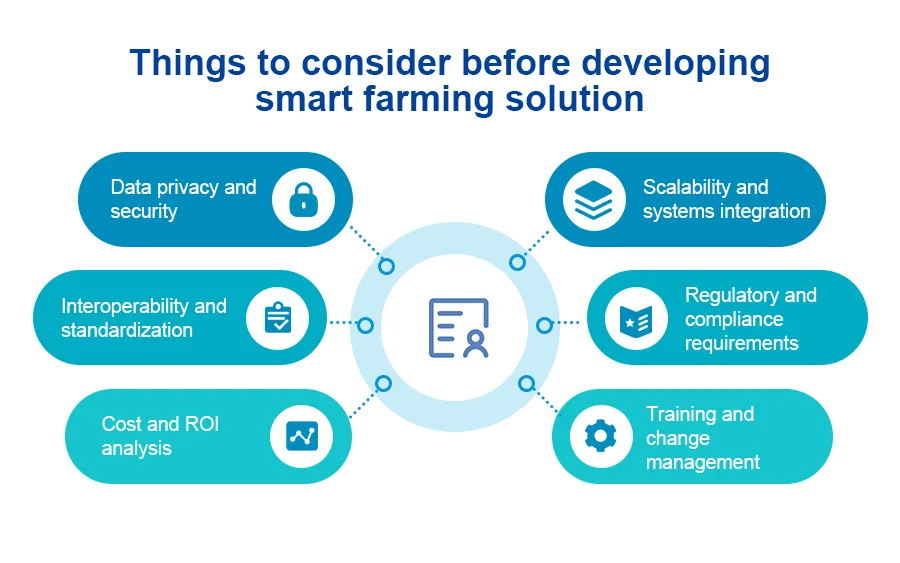
Data privacy and security: Agricultural operations create troves of proprietary data and records that must be secured against threats like malicious hackers or corporate espionage. Encryption, access controls, air-gapped networks and other cybersecurity measures should be implemented for any smart farming platform.
Interoperability and standardization: With proliferation of IoT devices and agricultural software from various vendors, interoperability and standardization across systems is crucial to facilitate integration and data sharing.
Cost and ROI analysis: Before adoption, a thorough cost-benefit analysis should be conducted to understand expenses like equipment acquisition, installation, connectivity/cloud services, maintenance, etc. Realistic ROI projections based on efficiency gains and yield improvements will justify investment.
Scalability and systems integration: Smart farming solutions must be able to scale up as IoT device deployments and data volumes expand year over year. Cloud infrastructure should support scaling computing and storage needs. Integration with existing equipment, sensors and software systems is also critical.
Regulatory and compliance requirements: Depending on the region, there may be regulatory requirements and compliances to adhere to involving areas like data privacy, agricultural inputs, chemical dispersal and other processes that IoT technologies must enable.
Training and change management: Implementing new IoT-driven processes often requires training teams on installation, maintenance and data interpretation to maximize solution effectiveness.
The future of farming is undeniably driven by smart digital technologies – with IoT serving as the core framework that senses, connects and automates agricultural operations. The fertile future of agriculture is digitized, optimized and ripe for reinvention. Ready to discover how IoT can cultivate serious growth for your agricultural organization? Contact our IoT expert to start mapping your path to intelligent, connected farming operations.
What types of sensors are commonly used in smart agriculture?
Common IoT sensors used include soil moisture, soil nutrient and soil temperature sensors, environmental monitoring of factors like rainfall and wind, and motion sensors and cameras for tracking livestock location and behaviors.
How is the data from agricultural IoT devices collected and analyzed?
IoT sensor data is transmitted wirelessly using connectivity like LoRaWAN, cellular, Wi-Fi or satellite, depending on on-site infrastructure. It feeds into cloud computing platforms to extract insights, detect issues and trigger automated workflows.
What level of connectivity is needed for remote farming areas?
For farms and fields located in rural or remote areas with limited internet/cellular coverage, low-power wide area network (LPWAN) technologies like LoRaWAN alongside satellite connectivity offer an efficient way to transmit IoT data over long distances using minimal power.
How can IoT improve food safety and traceability?
Connected IoT sensors generate a permanent, immutable record that links crops and livestock to specific space/time data across their entire supply chain journey. This data trail enables comprehensive traceability and root cause analysis in case of food contamination or safety issues.
What other emerging technologies work with IoT in agriculture?
While IoT forms the digital nervous system, smart farming frequently integrates other innovations like aerial drone imagery, autonomous robotics, computer vision and machine learning, blockchain-based traceability, HVAC and climate controls, and automated irrigation systems.
Table of Contents
Ready to craft end-to-end IoT Devices Solutions together?
Company
IoT Services


MOKOSMART
As a renowned loT devices solution provider, MOKO SMART can ensure that your project is leading the industry. Choose us to provide you with OEM or ODM services.
CONNECT WITH US
Copyright © 2026 MOKOSmart #1 Smart Device Private-Label Solution in China

 Store
Store