 Store
Store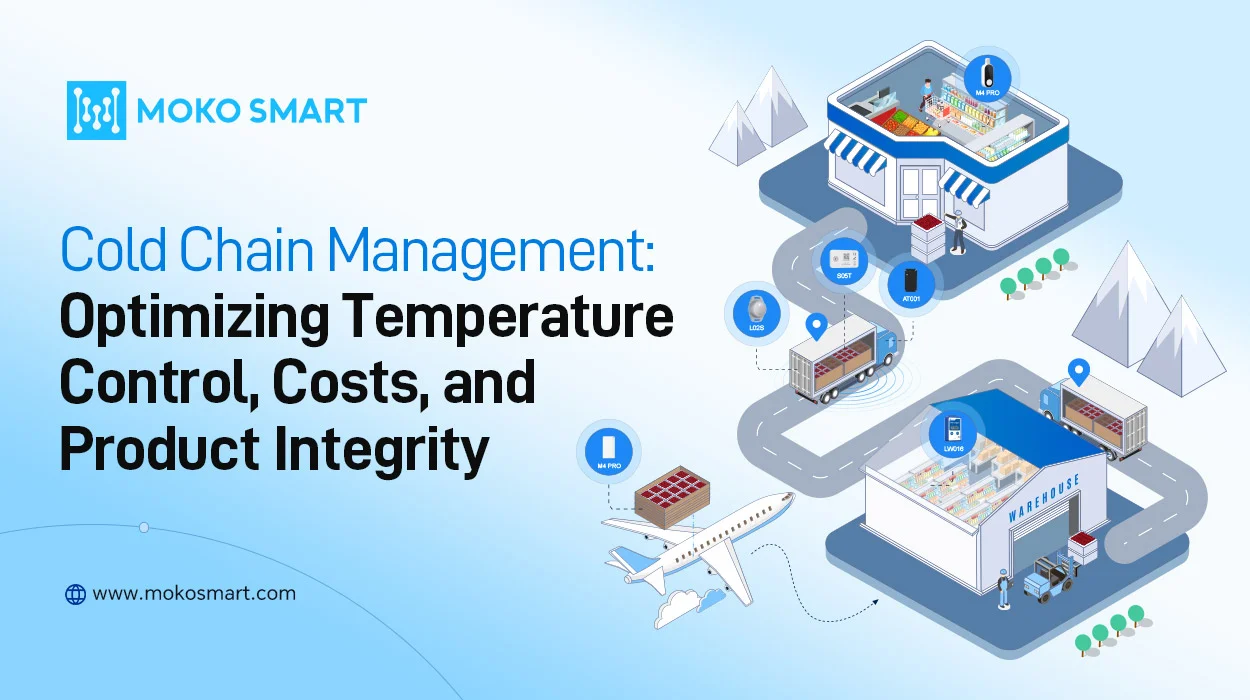
Paying closer attention to the importance of product integrity in modern cold chain management via asset and condition monitoring is necessary. From vaccines and pharmaceuticals to fresh produce and seafood, temperature-sensitive goods must stay within spec at every step: in storage, during loading, in transit, and at delivery. One delayed handoff or a door left open for minutes can compromise an entire batch.
Today’s cold chain monitoring can’t stop at “What was the temperature?” Visibility into temperature conditions is important. But strategic cold chain management requires more context: humidity, location, transit time, handling, compliance, and cost. IoT is a key technology to achieve these goals due to its many applications in providing real-time temperature monitoring data and management of products, vehicles, and storage facilities. In the post below, we’ll take an in-depth look at cold chain management and its applications.
What is cold chain management?
Cold chain management involves managing and optimizing the flow of temperature- and humidity-sensitive goods and services. This includes temperature-controlled storage, transportation, and monitoring, but it goes beyond simply “keeping it cold.”
Temperature monitoring tells you what the temperature is. cold chain management ensures products stay within validated limits across every step, and that any deviation is detected, handled, and documented. The process starts with the preservation of perishable materials and follows them all the way through cold storage and distribution until they reach the customer. It covers controlled storage and transport, handling and dwell time, time out of range, location visibility, and compliance records needed for audits and quality assurance. Cold chain IoT is especially expected to have a significant impact across the pharmaceutical, food, and agriculture industries.
One primary area in the cold chain logistics is temperature-related issues. This includes:
- Temperature excursions (out-of-range events)
- Spoiled products
- Lost shipments
- Expensive monitoring systems
On top of this, there’s also difficulty in tracking temperature and compliance or locating breakdowns across multiple handoffs and environments.
How cold chain management and monitoring systems work
IoT cold chain systems bring end-to-end visibility to temperature- and humidity-sensitive goods by combining sensors, connectivity, gateways, and a software platform. So conditions are continuously tracked from origin to destination, and exceptions can be acted on quickly.
In practice, the majority of IoT systems can be thought of simply:
- Sensors detect temperature, humidity, and other event (door-open event) occurrences.
- Connectivity and gateways ensure the transmission of data from various contexts (cargo, warehouse, vehicle, refrigerator).
- The platform displays dashboards, alerts and maintains records to be used in reporting and compliance.
Going out of range, the goal is not only to see it, but to identify where it happened, respond quickly, and leave a record to be documented and further used for audit and investigation.
The following is about a cold chain transportation of fruits, an example of an end-to-end continuity of the cold chain.
End-to-end example: IoT in fruit cold chain transportation
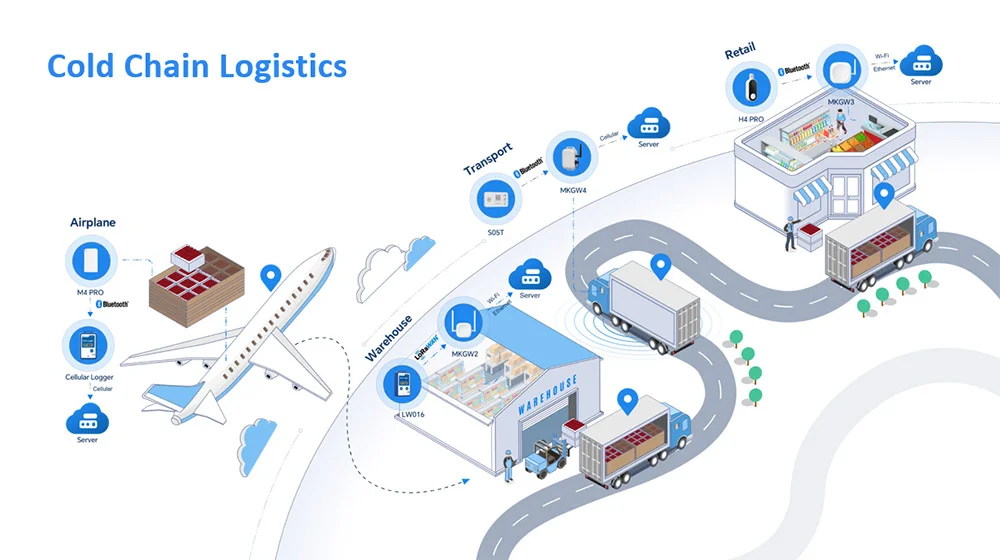
1) Air freight: monitor inside the cargo
Bluetooth sensors and Cellular data loggers are installed in the cargo boxes to record the temperature and humidity at all times. Stakeholders are able to identify anomalies in real time and take action before quality is impacted. This can also come in handy during handoffs when effective time and condition documentation can reduce disputes.
2) Local warehouse: stabilize the storage environment
After delivery, LoRaWAN data loggers and gateways can be installed throughout the warehouse to monitor the overall conditions and make sure that the fruit is stored within the required range.
3) Warehouse to stores: track the delivery leg
Next comes local delivery of the warehouse to supermarkets or fruit stores. Cold chain vehicles may be loaded with Bluetooth sensors and a cellular gateway, which allows monitoring of the entire process of delivery in real time. Real-time visibility is especially valuable in last-mile delivery, where delays and frequent door openings can increase excursion risk.
4) Destination: protect the final preservation stage
At supermarkets or cold rooms, Bluetooth sensors and gateways can be placed in refrigerators or storage areas to check the conditions until the point of sale.
With the above, a complete IoT-based cold chain solution combining BLE, LoRaWAN and Cellular is achieved.
To simplify cold chain project evaluation, a Cold Chain Demo Kit from MOKOSmart can help users quickly test scenarios. It includes four Bluetooth beacons (M4 PRO, H4 PRO, S05T, L02S) and a Bluetooth gateway (MKGW3). Users can build and validate monitoring workflows from individual packages to storage environments without complex setup. The kit can also be integrated with ThingsBoard for real-time dashboards and monitoring.
What types of products can be monitored?
Organizations monitor a wide range of temperature-sensitive products, each of which benefits from a management approach:
High-compliance pharmaceuticals: Vaccines, biologics, insulin, specialty drugs, blood products.
High-loss perishables: seafood, meat, dairy, fresh produce.
Chemical and laboratory products: Laboratory samples, reagents, cultures, specimens.
Industrial sensitive materials: Chemicals, adhesives, sensitive electronics, specialty materials.
A cold chain management system covers all these categories, not just the obvious fresh and pharmaceutical products.
Challenges and considerations in cold chain monitoring
The real operation of implementing and maintaining IoT in cold chains may have real challenges. Choosing a cold chain management solution, the following would help to facilitate a successful rollout and long-term success.
Start with clear goals. Identify what you want to improve with IoT, such as monitoring frequency, excursion response, or compliance reporting. This helps you in selecting the right devices, connectivity, and workflows.
Choose a trusted solution and hardware partner. Work with an industry expert who has a proven track record in cold chain IoT deployments.
Plan integration early and design for scalability. List your existing software systems across departments, from WMS and ERP to transportation and quality systems, to streamline integration and avoid creating another data silo.
Define the accuracy you actually need. IoT offers different levels of precision, so match temperature and location requirements to product value and regulatory expectations.
Select sensors wisely. Choose sensors that fit the use case and environment, and that meet product and compliance requirements.
Train staff for adoption. Hands-on training helps teams understand how the system works and how to respond when excursions happen.
Maintain and improve over time. Conduct periodic reviews and updates to keep device performance, data quality, and reporting reliable.
The benefits of IoT in cold chain management often outweigh the challenges. Having a clear plan and the right partners, you can roll out quicker, mitigate risks during implementation, and enjoy the benefits of IoT sooner.
Real-world examples of using IoT in cold chain monitoring
It’s always helpful to learn from real deployments of IoT in cold chain management. The following are some of the examples from MOKOSmart partners.
Ghana Supermarket Refrigerated Food Monitoring
In its refrigerated storage area, a Ghanaian chain supermarket deployed an automated cold chain monitoring solution to replace manual fridge checks to reduce spoilage risk. The supermarket adopted MOKOSmart cold chain devices, which guaranteed:
– all refrigerator equipped with H4 BLE temperature monitoring sensors
– 24/7 visibility with data-driven insights, 365 days a year
– Instant alerts for abnormal fluctuations and refrigerator malfunctions
These H4 Bluetooth T&H sensors transmit data through MK107 BLE to Wi-Fi gateways to the client’s platform. Employees are then able to keep track of refrigerator conditions in real time.
Brazil & Turkey Hospital Refrigerator Temperature Monitoring
Hospitals always require an effective means of monitoring medication and vaccine refrigerators, particularly older ones that lack built-in monitoring.
To address this, H4 BLE temperature sensors were installed inside refrigerators to capture accurate, real-time data at customizable time intervals, with S03D door sensors adding visibility into door-open events.
The data is sent through the MKGW1-BW Pro BLE gateways to the centralized platform to provide continuous monitoring, faster intervention during malfunction, and better security for temperature-sensitive medical devices.
Optimize your cold chain with MOKOSmart
IoT plays a major role in improving product integrity in cold chains through better condition and asset monitoring, increased staff productivity, smoother product flow, and overall product safety. If your organization is ready to see how effective cold chain solutions can drive cost savings, improve utilization and support better outcomes, MOKOSmart stands ready to help. All you need to do is just reach out to our team for a consultation.
FAQs about cold chain management
What is a cold chain break?
A cold chain break happens when temperature-sensitive products go outside validated limits over a duration of time. This may happen either when in storage, loading, transit or delivery. Teams are increasingly moving towards real-time, technology-driven monitoring systems that ensure rapid intervention and protect product integrity.
What happens if the gateway or network is offline?
A reliable solution should consider offline scenarios and data continuity. Many Bluetooth temperature sensors can store readings locally when the gateway or network is unavailable. Once connectivity is restored, the gateway can read and upload the historical data, so you still have a complete temperature record.
Can a cold chain management solution integrate AI?
Yes. You can integrate AI with cold chain platforms like ThingsBoard to improve monitoring and decision-making.