IoT in Retail
Home > Application > IoT in Retail: How IoT is Shaping the Future of Retail Industry
The retail game has changed. E-commerce titans and picky buyers have flipped traditional selling on its head. With IoT, retailers can finally wave goodbye to outdated, one-size-fits-all shopping experiences. Sensor-laden smart shelves provide real-time inventory tracking, while in-store heat maps reveal the hot zones that draw the most foot traffic. And with IoT enabling targeted promotions and personalized digital signage, retailers can serve up delightful, memorable shopping journeys tailored to each customer. Those who master IoT will emerge to thrive in today’s competitive commerce landscape.
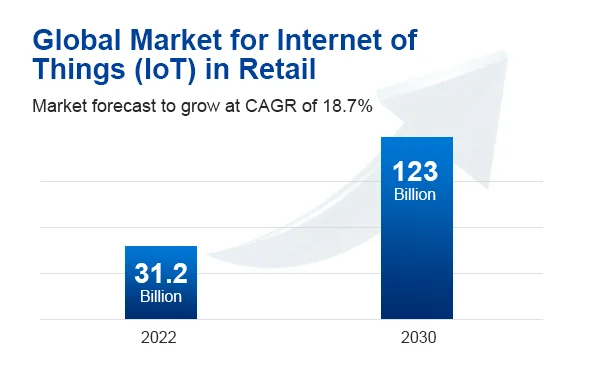
The IoT in retail market is exploding, projected to hit $123B by 2030 with 18.7% CAGR, driven by demands for personalized shopping, efficient supply chains, and data-driven insights.
Traditional brick-and-mortar retailers are feeling the heat from shifting consumer preferences and e-commerce’s disruptive force. IoT provides respite by optimizing operations end-to-end – precisely calibrating inventory levels while delivering memorable customer experiences that cultivate loyalty. Smart IoT devices and applications can make the retail experience smoother and more efficient.
As consumer needs keep evolving, adopting IoT technologies is becoming critical for retailers looking to stand out and unlock new growth opportunities in an increasingly digital world. Those that fail to get on board with IoT run the risk of falling behind more innovative competitors.
IoT has numerous applications in the retail industry, each designed to enhance different aspects of the shopping experience and streamline operations. Here are some of the most popular IoT applications in retail:
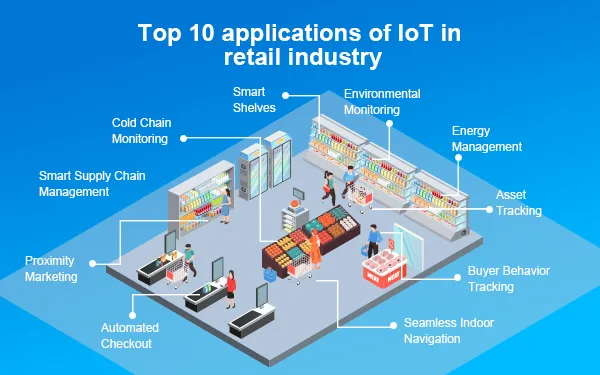
Effectively managing their supply chain is a common issue for most retail stores. RFID tags and Bluetooth beacons can track and monitor the movement of goods, enable real-time tracking of inventory levels, and optimize stock replenishment.
Bluetooth beacons for proximity marketing are the perfect way to integrate IoT in retail. They can be used to send customers notifications based on their location on personalized discounts or certain events. The location data can also be used to send sales associates to areas where customers are staying to improve the customer experience.
In large retail stores, customers can pull up turn-by-turn directions on their phones to quickly find the products, departments or amenities they’re looking for. Wayfinding tags and apps enable this seamless indoor navigation, enhancing the shopping experience. The positioning data also gives retailers valuable insights into shopper journeys and dwell times to optimize store layouts.
Smart shelves use IoT weight sensors and RFID tags to monitor inventory levels on display and stock shelves. They detect out-of-stock items, prompt replenishment, track misplaced items, and offer real-time inventory data to staff via mobile apps. This automation streamlines operations while also cutting down manual tracking and ensuring proper stocking of products.
With the help of IoT technology, you can track your store assets with ease with just a few clicks on your phone, tablet, or computer. Sometimes, it becomes very hard for store employees to track them physically. Bluetooth asset tags can be used to keep track of shopping carts preventing any theft cases. Furthermore, with beacons, retailers can always ensure they are enough shopping carts for customers.
Customers despise checkout – it’s the most time-consuming and labor-intensive part of shopping. Many individuals simply leave without purchasing anything when checkout lines are overly long. Retailers can employ IoT devices to automate their point-of-sale (PoS) systems. When a consumer exits the store, the PoS can read the product tags in their cart and automatically charge them via a mobile payment app. No more waiting in lengthy lines to make a purchase.
Energy is always a costly expense for most retail stores. However, with our smart plug and energy monitor/meter solutions, retail stores can monitor their energy consumption in real time. This will help retailers figure out how to make energy use more efficient and help to reduce their energy bills.
Cold chain monitoring is a great way to use IoT in supermarkets and pharmacy. IoT will assist in monitoring the temperature, humidity, and any other parameters that will help ensure that perishable goods remain fresh for the longest time possible.
In the retail industry, where employees spend substantial time indoors interacting with customers, maintaining a fresh and comfortable indoor environment is essential. IoT sensors for retail track indoor air quality factors such as carbon dioxide, temperature and humidity, preventing employees and customers from experiencing uncomfortable symptoms such as dizziness.
An excellent way to ensure customer satisfaction is to anticipate your customers’ needs and be able to fulfill them. Internet of Things devices like occupancy sensors and beacons will gather information on in-store activities and identify the prime spots to place products that need to sell quickly and the best layouts to use.
IoT is bringing forth a wealth of opportunities for retail businesses, with new solutions and strategies evolving rapidly. Crucially, these transformative technologies are now within reach for not just major chains but also smaller retailers. By embracing IoT, retailers can harness the following advantages:
Achieving the full potential of IoT in retail requires leveraging a range of cutting-edge technologies. Here’s a breakdown of some IoT technologies reshaping the retail landscape:
Currently, IoT devices are being used and are thriving in the Retail Industry. Here are four success stories of IoT solutions being used in the retail sector.
Amazon Go
This is likely one of the most well-known uses of IoT in retail. These Amazon convenience stores provide a way for people to go shopping cashless. People just walk in, pick what they want, and walk out. I know, sounds something straight out of a shoplifter’s dream, right? But Amazon Go is a very real convenience store.
The app works with the Amazon Go app, which is used to bill any items you choose to your Amazon account. Amazon Go shops have sensors that can pick up when items are taken or returned to shelves, and they will assist in keeping track of what a customer buys to ensure they are properly charged.
Target’s Beacons
Target’s has been successfully using IoT beacons connected to its Target Run app to market to its customers depending on their location. As long as a customer has the app and has their Bluetooth on when they enter a Target store, they will receive notifications on different products and promotions.
Urban Outfitters’ Loyalty Program
Urban is successfully using beacons to attract the younger market. The beacons which are placed at the entrance, fitting rooms and checkout all work together to improve customer satisfaction.
Upon entry into an Urban Outfitters, the beacon will urge any smartphone wielding customer to unlock a special offer via social media. In the fitting rooms, the beacons will generate customer-specific content on products. They will also be requested to take a selfie with their products, and post it on Instagram with #UOonYou giving them the chance to appear on the company’s website.
Macy’s Mobile App
Macy’s has also successfully used Bluetooth beacons to offer the customers a more personalized shopping experience. Bluetooth beacons work in conjunction with Macy’s app in that anyone who opens the Macy’s app while in the store, the location will immediately be noted and they will receive notifications on products based on the section they are in.
Despite the many benefits and applications of IoT in the Retail Industry, there are still challenges.
However, by working with cybersecurity experts and having robust security strategies in place, retail stores can mitigate the security risks IoT poses.
Nevertheless, one thing retailers need to remember is there is no need to buy every infrastructure at once. They can begin by putting in a small IoT solution at first and then grow from there.
However, retailers can easily overcome this by hiring their own IoT experts to help them handle the technicalities of IoT devices. They can also outsource their needs to third-party companies specializing in IoT.
IoT is rapidly transforming the retail landscape, and its impact is only expected to grow in the coming years. As retailers look to provide more digitized, convenient and personalized shopping experiences, they will increasingly turn to IoT technologies and solutions. Here are some of the key trends that will shape the future of IoT in the smart retail space:
What should retailers do to match the standards of their new customers? The answer lies in the recent technology revolution—IoT in Retail. Retailers need to welcome the Internet of Things with open arms to break the wall between brand, product, and customer.
Choosing to integrate IoT is just the first step – retailers must also select the right IoT company to fully reap the benefits. MOKOSmart is the reliable hardware solution partner retailers should choose for their IoT journey. MOKOSmart offers a wide range of innovative IoT devices that help build IoT solutions for smarter retail operations.
Table of Contents
Ready to craft end-to-end IoT Devices Solutions together?
Company
IoT Services


MOKOSMART
As a renowned loT devices solution provider, MOKO SMART can ensure that your project is leading the industry. Choose us to provide you with OEM or ODM services.
CONNECT WITH US
Copyright © 2026 MOKOSmart #1 Smart Device Private-Label Solution in China

 Store
Store